

It’s Thanksgiving today… So Happy Thanksgiving! This post has nothing to do with that. I’m just writing about switching Google Antigravity models and orchestration.
On a side note: my new plan for post thumbnail generation is to just drop the post thumbnail into each post after the first paragraph to allow Substack to pick it up automatically. This one was generated by just asking Gemini to read this post and make a thumbnail for Substack. This seems like a repeatable method of generating thumbnails so you have that to look forward to going forward.
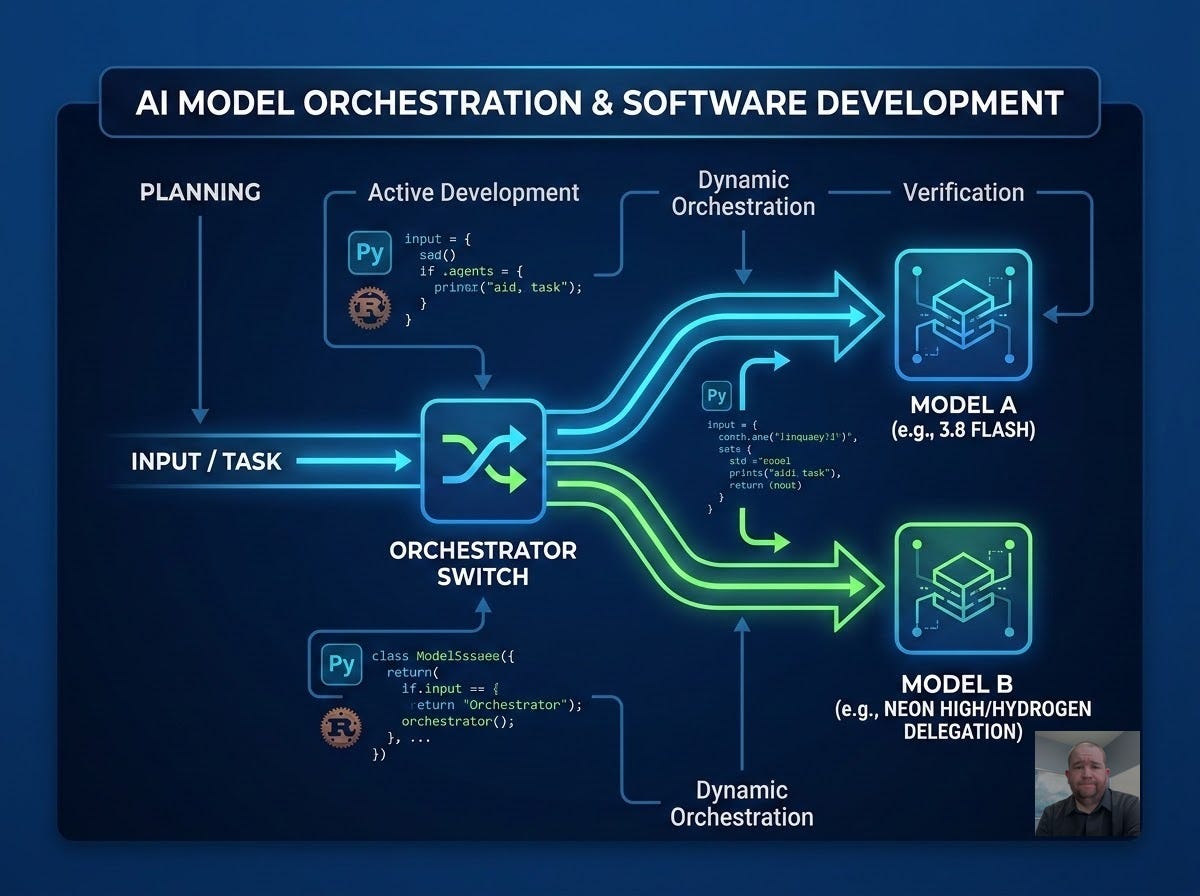
My coding efforts right now are primarily in the Python and Rust languages. I’m using Google Antigravity as my agentic development platform. I had been pretty set on using the Gemini 3.8 Flash model set on Medium until this week. It worked out best for what I was doing. This last week I have moved over to using Orchestrator Gemini Neon High which sometimes delegates to the Hydrogen model for tasks. Most of my coding efforts are set within a process of using the /plan command to develop a specific set of coding actions collected into a very detailed plan document. You have to be in agreement with each plan and pretty sure what code is going to be developed to move along safely using this approach. I have been using a GitHub based branch and merge strategy to allow rolling back if we take a wrong turn. The switch between 3.8 and Neon was okay and I have not burned my weekly token allotment. Instead of using the /teamwork command which will cause a massive token usage spike when you are working with complex commands or a large code base I tend to use /goal which keeps it focused on sequential work vs. spawning a bunch of subagents. This is a big trade off in time to get better development quality. Agent swarms are expensive and when you are carefully tracking your token spend you may want to avoid allowing such actions.
I accidentally unleashed a /goal command bug hunt that ran for a long time (5 hours) and swept the entire project for items which returned about 1,000 documented things which surprised me at the time. Apparently, the bug hunt is considered an adversarial effort so it will just keep finding and thinking about bugs, edge cases, and alternative methods to do things. My expectation for the effort is that after a certain number of bug hunts we would have certified code. You have to really prompt the model differently to get that type of output. This is one of those examples where the /btw command is super helpful to break out from the current conversation to consider a side quest or ask questions about the current agentic development efforts. To review specific code changes or look at the changes in a lot more detail this is the best way to do that without diverting the development you really do have to utilize the /btw or you change the coding direction in meaningful ways. You introduce a signal to the current work that you are interested in something that might not be all that important to the current objective, but you create focus on that instead of the principle /goal command being worked on during active development.
I’m still running into contention where the time it takes to do specific code changes from one plan to another means that I’m already thinking about 2-3 plans to deliver after the current changes wrap up which is problematic. Launching work on those next plans without the previous changes being in place leads to drift and problems. I know the standard way to handle this is to create branches and merge back to check for conflicts, but since the project I’m working on uses a core framework for execution any attempt to create branches creates a lot of rework to merge and handle conflicts. It’s a problem in terms of having to make decisions without running the performance and test suite against those merge decisions. They can happen very quickly without an understanding of the consequence in terms of performance. One of the major problems with this type of agentic development is that it will move forward rapidly, but you don’t know if those decisions helped until the development is paused to run the verification suites.
Right now I have 4 different test suites that verify the project, but they take several hours to execute at this point which means we have to reach a stable stopping point in development before committing that time to find out the effectiveness of the changes. Even benchmarking during a run only provides a single slice look at if the change was effective. Anything with a complex workflow is going to run into this type of problem. Sure the test suite runs on any code change that is good, but it does not provide the same telemetry as the performance benchmarks that take several hours to complete. These are the things I’m thinking about today during my coding efforts. I’m working 3-4 current projects right now and the Google Antigravity agentic development platform seems to handle that segmentation well enough. Each project is linked to a repo and a discrete set of code so that helps maintain effective controls for working on several things at the same time. I tend to hop around from the various projects driving the work forward since I’m spending so much time waiting for actions to end up completing. This coworking dynamic seems to help let me stay productive during the periods of waiting on something to complete.